
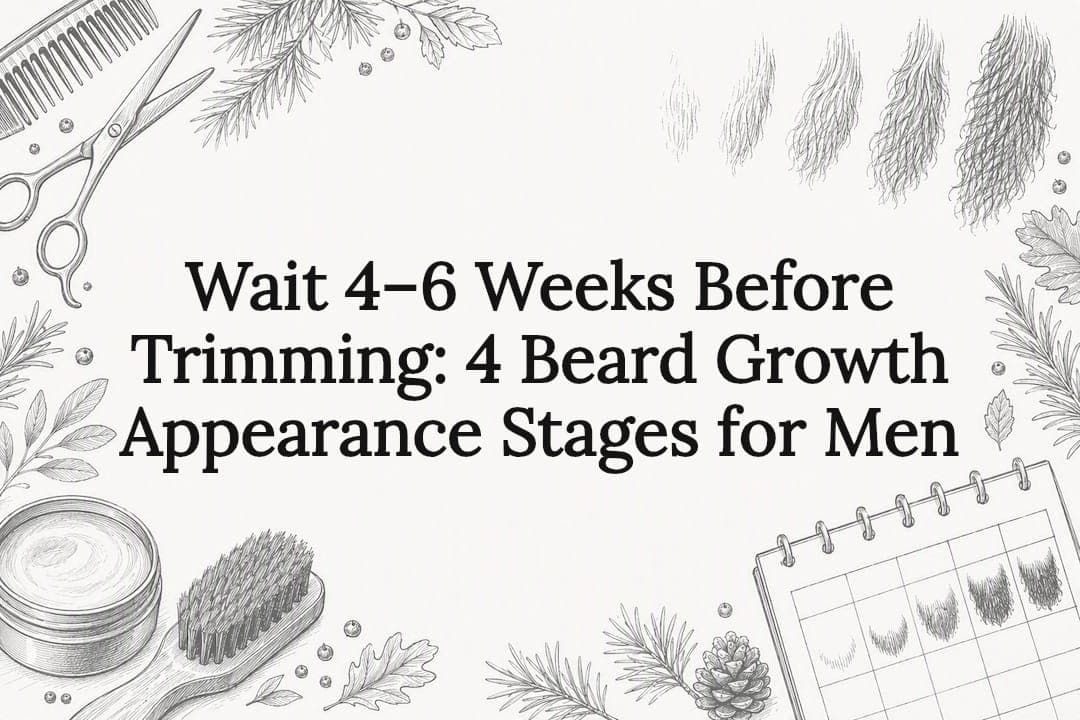
Most men move through four visible stages: patchy early fuzz, an awkward uneven phase, a gradual densifying period, and finally a mature, fuller beard. The first honest read on your pattern usually shows up around 4 to 6 weeks. Real density often takes several months, and some men keep filling in through their late 20s and 30s. Basic care sharpens the look of what you have, but it cannot manufacture follicles you weren't born with.
TL;DR:
- Beard patches often resolve naturally after 6 months, but patience is key, especially during the awkward phase when patchiness peaks between weeks 4 and 8.
- Genetic factors, including follicle sensitivity to DHT, primarily determine where the beard grows thick or remains sparse, regardless of hormone levels.
- Proper exfoliation, gentle cleansing, and daily use of beard oil improve appearance and reduce irritation, but do not speed up follicle growth.
- Shorter styles around 4 to 5 millimeters effectively mask uneven density by blending thin and thick hairs, making styling the main solution for patchiness.
- Avoid trimming or over-washing during early growth stages, as such habits often hinder progress and prolong the appearance of patchy beard growth.
Table of Contents
- How Does Beard Growth Appearance Change Over Time?
- Why Do Some Beard Areas Grow Thicker Than Others?
- How Do You Fix Patchiness, Itch, and Ingrown Hairs?
- What Daily Grooming Routine Improves Beard Appearance?
- Which Beard Styles and Lengths Hide Patchy Growth?
- Which Beard Habits Are Actually Hurting Your Progress?
- What Makes a Beard Care Routine Trustworthy?
- A Note on Patience From Someone Who's Watched a Lot of Beards Go Wrong
- Start Your Routine With the Right Products
- Sources
- FAQ
How Does Beard Growth Appearance Change Over Time?
Every beard follows a rough timeline, though the pace varies by person, region of the face, and even the season. Knowing which stage you're in stops you from making decisions, like reaching for the trimmer, that you'll regret three weeks later.
Weeks 0 to 4: early fuzz. This is the shadow stage. Hair is soft, thin, and grows in unevenly, especially along the cheeks and under the jaw. Some patches will look almost invisible in certain light and obvious in others. This is normal and tells you almost nothing about your final pattern yet.
Weeks 4 to 8: the awkward phase. Hairs start overlapping instead of standing alone, and you'll notice real texture and color differences between the mustache, chin, and cheek zones. Itching often peaks here as the hair shaft pushes through and curls against the skin. This is also when patchiness looks its worst, right before it starts resolving.
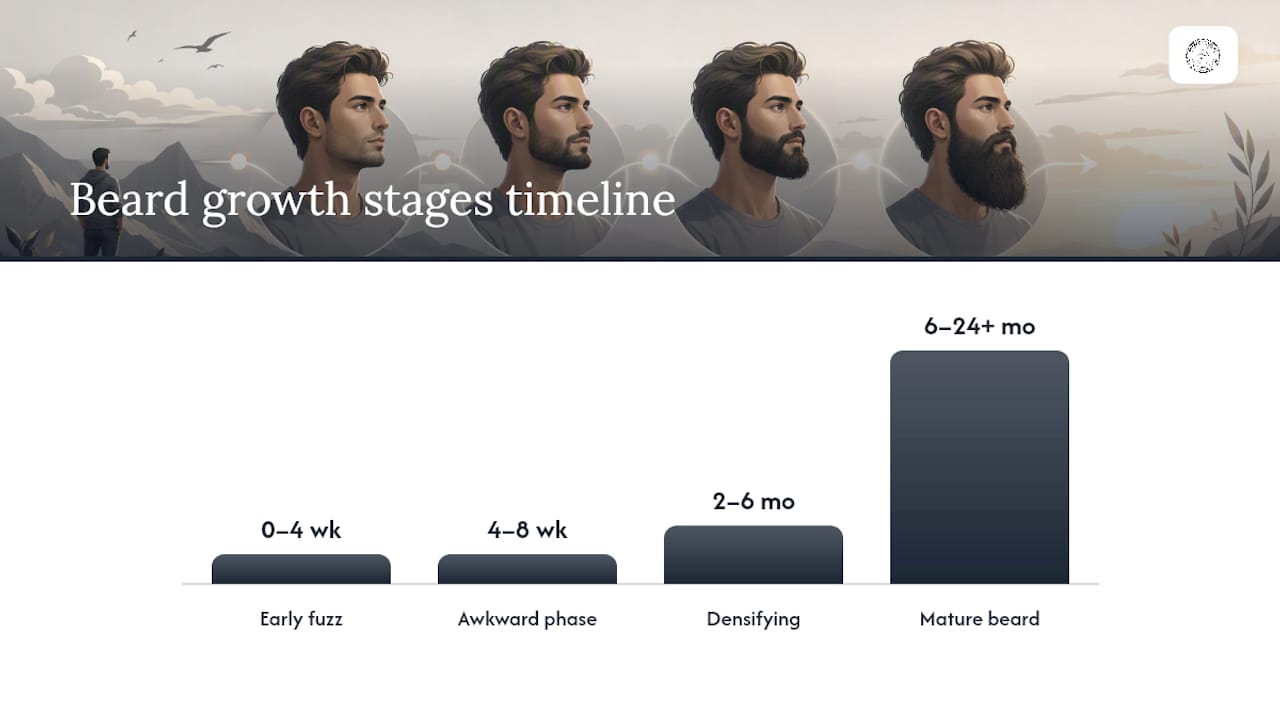
Months 2 to 6: densifying. Individual hairs thicken, the cheek line firms up, and coverage that looked spotty starts reading as intentional stubble rather than missed spots. Growth rate itself doesn't accelerate. According to Gillette's grooming research, beard hair grows at roughly half an inch per month on average, so what changes here is the appearance and coverage catching up to that steady growth.
Months 6 to 24-plus: mature beard. Full length, settled color, and a pattern that's about as good as your genetics will produce at your current age. Many men see incremental filling in through their late 20s and even into their 30s, so a beard that looks moderate at 22 can look genuinely full by 29.
- Early fuzz: soft, sparse, patchy shadow
- Awkward phase: overlapping hairs, peak itch, uneven texture
- Densifying: cheek line firms, stubble reads as deliberate
- Mature beard: full length, stable pattern, ongoing slow improvement into later years
Why Do Some Beard Areas Grow Thicker Than Others?
Genetics sets the ceiling on your beard, and hormones decide how close to that ceiling you'll get. Dermatologist Dmitri Wall has pointed out that genetics, age, and androgen sensitivity are the biggest levers in how a beard fills in, according to reporting on beard growth science. Testosterone alone doesn't explain the differences you see between two men with similar hormone panels. It's follicle sensitivity to dihydrotestosterone (DHT) that determines whether a follicle produces thick terminal hair or stays stuck on fine vellus fuzz.
Follicles also don't grow on the same clock. Each one cycles independently through growth (anagen), a brief transition (catagen), and rest (telogen), which is why your chin can look fully bearded while your cheeks still show gaps. This asynchronous cycling, explained in detail by grooming researchers at IronMane Grooming, is the biological reason patchiness looks worse in some zones than others, and why it often smooths out over months rather than weeks.
Clinical work backs this up with actual classification systems. A progressive morphological classification published through ISHRS research maps out distinct beard presentation types, from sparse coverage to fully dense patterns, along with how density differs by facial zone. That kind of clinical mapping is also why specialists can set realistic expectations before recommending any medical intervention.
Follicle sensitivity to androgens, not raw testosterone level, is what separates a dense beard from a patchy one in men with otherwise similar hormone profiles.
If your uncle or father had thin cheek coverage, expect a similar pattern rather than betting on a routine to override it.
How Do You Fix Patchiness, Itch, and Ingrown Hairs?
Patchiness usually falls into one of two categories: a timing issue that will improve on its own, or a genuinely low-density zone that won't fill in no matter how long you wait. If you're under 8 weeks into growth, give it more time before drawing conclusions. If a patch hasn't changed in 6 months, that's likely your baseline pattern, and styling becomes the better tool than patience.
Most of the day-to-day appearance complaints, itch, dryness, breakage, and ingrown hairs, respond to a handful of consistent fixes.
- Exfoliate the skin under the beard once or twice a week to clear dead skin and free trapped hairs before they curl inward.
- Switch to a gentle, sulfate-free cleanser; harsh soaps strip natural oils and make itch and flaking worse.
- Apply a lightweight beard oil daily to soften the hair shaft, which reduces the itch that comes from stiff, dry hair poking the skin.
- Use a warm compress on inflamed ingrown hairs for a few minutes to soften the skin and encourage the hair to release on its own.
- Trim only stray outlier hairs once your pattern has stabilized, not the whole beard, while you're still in the early fuzz or awkward phase.
Pro Tip: Brush against the grain once a week during the awkward phase. It lifts trapped, curled hairs before they become ingrowns, and it shows you exactly where your patchy zones actually are instead of guessing.
See a dermatologist or hair specialist if you notice sudden patchy loss, scarring, persistent inflamed bumps, or a pattern that changes shape rather than just filling in. Those signs point to something beyond normal growth variation, and self-treating can make scarring-related hair loss worse.
What Daily Grooming Routine Improves Beard Appearance?
A beard looks healthier through conditioning and shaping, not through anything that changes how many follicles you have. Setting that expectation up front keeps you from chasing products that promise density they can't deliver.
Daily routine:
- Wash with a gentle beard cleanser 2 to 3 times a week, not every day, to avoid stripping natural oils.
- Towel-dry gently rather than rubbing, which reduces frizz and breakage.
- Work a few drops of beard oil through from skin to tip while hair is still slightly damp.
- Brush or comb in the direction of growth to train hairs and distribute oil evenly.
Weekly routine:
- Apply a light beard balm for hold and shape on days you want a more defined edge.
- Exfoliate the skin underneath once or twice a week.
- Trim only stray, outlier hairs once your pattern has stabilized. Save real shaping for after week 6 to 8.
Barber and style guides consistently rate heavy stubble, in the 4 to 5 millimeter range, as one of the most flattering lengths precisely because it visually equalizes thin and thick zones. That's a styling win, not a growth one. Oils and balms condition the hair shaft and reduce breakage and frizz, which makes existing hair look fuller and healthier, according to Gillette's beard science overview, but they aren't creating new follicles.
Feared Beard VT's beard oils and beard balms are built around that conditioning role: hydrate the skin underneath, soften the hair shaft, and give you the shaping hold to work with whatever stage you're currently in.
Which Beard Styles and Lengths Hide Patchy Growth?
The length you choose does more for perceived fullness than almost any product. Heavy stubble at 4 to 5 millimeters remains the most forgiving length for uneven density because short hairs of slightly different thickness blend together instead of standing out individually. A low trim at 3 to 4 millimeters works for men whose pattern is mostly filled in but still a bit inconsistent along the jawline.
If your goal is a longer beard, the "long game" approach matters: let it grow untouched for at least 4 to 6 weeks before judging or shaping, since longer hair naturally overlaps and covers thin patches that would look obvious at a shorter length, a point echoed across current patchy beard style guides.
Fades and tapers are your best tool for thin cheek lines. A gradual fade from a fuller chin into a shorter, tapered cheek turns a weak zone into what reads as a deliberate design choice rather than a gap.
Face shape changes which lengths flatter you most:
- Oval faces can wear almost any length, from heavy stubble to a full beard, without much risk.
- Round faces benefit from more length at the chin and tighter sides to add visual length to the face.
- Square faces look sharper with slightly rounded edges rather than a hard geometric line, softening the jaw.
- Oblong faces do better with fuller sides and a shorter chin to add width rather than length.
Which Beard Habits Are Actually Hurting Your Progress?
Most disappointing beards aren't a genetics problem. They're a patience problem. Trimming during the awkward phase, weeks 4 through 8, is the single most common self-inflicted setback, since you're cutting off hair right before it starts overlapping and covering the very patches you're trying to fix.
A few other habits worth dropping:
- Washing daily with regular bar soap, which strips oils and leaves the beard dry, dull, and itchier than it needs to be.
- Using high heat from blow dryers to "train" hair, which damages the shaft and increases breakage.
- Expecting shaving to make hair grow back thicker. It doesn't change density or follicle count at all.
- Chasing unproven topical serums or systemic drugs without medical guidance. Some ingredients have real research behind them, but plenty of marketing claims outpace the evidence.
Impatience, more than biology, is why a lot of guys quit growing before their beard ever gets the chance to look good.
What Makes a Beard Care Routine Trustworthy?
Real conditioning benefits, not vague promises, are what separate a useful beard product from a gimmick. Feared Beard VT's beard oils and beard balms are formulated to hydrate the skin underneath, reduce frizz, and support a healthier-looking beard as it moves through each growth stage.
A few things worth knowing about why the ingredients matter:
- Small-batch, 100% natural formulations reduce the risk of irritation for men with sensitive skin, which matters most during the itchy awkward phase.
- Ingredient sourcing is documented on the ingredients page, so you can see exactly what's going on your face before you buy.
- Consistent, repeat use tends to matter more than any single product. Conditioning benefits build over weeks, not overnight.
Author credentials and detailed case studies from Kyle's grooming background will be added here as they're finalized.
A Note on Patience From Someone Who's Watched a Lot of Beards Go Wrong
The single biggest lever most men have isn't a product. It's a self-imposed rule: don't touch the trimmer for at least 6 to 8 weeks, no matter how ragged things look in week 5. That's the stretch where the overlap finally kicks in and patches that looked hopeless start reading as intentional texture.
The habit I see backfire most often is over-washing. Guys treat beard hygiene like scalp hygiene and strip the oils that were making their beard look healthier in the first place. Back off the daily wash, add a few drops of oil, and give the awkward phase the time it actually needs.
— Kyle
Start Your Routine With the Right Products
You can support your beard through every stage without paying agency-style markups for "beard growth systems" that promise more than conditioning can deliver. The starter combo that makes the most sense for most stages is simple: a beard oil for daily hydration and shaft conditioning, paired with a beard balm for light hold and shape once your pattern starts to stabilize.

The oil goes to work from skin to tip, softening hair so it lies flatter and looks less wiry during the itchy weeks. The balm adds enough structure to train stray hairs into your shape without the stiffness of heavier waxes. Both are made in small batches with natural ingredients, so sensitive skin isn't fighting your grooming routine while it's already dealing with new growth. If you're heading into weeks 4 through 8 and want your beard to look its best while you wait it out, browse the full beard oil and balm lineup and pick the scent and formula that fits your routine.
Sources
- How to grow a beard, according to experts
- Progressive morphological classification for evaluating beard hair presentation patterns
- Beard Growth Science: How to Grow and Care for Your ...
- 28 Patchy Beard Styles That Actually Work (2026)
FAQ
What Are the Signs You're Growing a Beard?
The earliest sign is a fine, soft shadow across the cheeks and chin that thickens and darkens over the following weeks. You'll also notice itching as hairs push through the skin, followed by visible overlap between individual hairs around week 4 to 6.
Does a Beard Change Its Appearance Over Time?
Yes. Beard hair typically shifts from soft and thin to coarser and darker as it matures, and coverage that looks patchy early on often fills in as follicles catch up to each other over months, per Gillette's growth research. Texture, color, and density can all continue changing into a man's late 20s or 30s.
At What Age Do Most Men Develop Their Full Beard Pattern?
There's no single age, since genetics and androgen sensitivity vary widely between men, according to dermatologist-backed reporting. Many men see their pattern mostly settle by their mid-20s, though continued filling in through the late 20s and 30s is common.
What Should 3 Weeks of Beard Growth Look Like?
At 3 weeks, expect a soft, uneven shadow with visible gaps, especially along the cheeks, and individual hairs that haven't yet started overlapping. This is still the early fuzz stage, and judging your final pattern this early is premature. Wait until at least week 6 before deciding whether to reshape or keep growing.