
Daily oil on a damp beard, a gentle wash two to three times a week, damp detangling with a wide-tooth comb, light balm for shape, and conservative trims. That five-part loop, repeated for four to eight weeks, is the entire foundation of curly beard care. Everything else in this guide is technique and troubleshooting layered on top of it.
TL;DR:
- Using a regular washing routine of two to three times weekly with sulfate-free cleansers prevents stripping essential oils that keep curls moisturized.
- Applying beard oil immediately after washing and while the beard is slightly damp helps lock in hydration and maintain curl shape without heaviness.
- Detangling should be done when the beard is slightly damp using fingers followed by a wide-tooth comb to avoid breakage and snags.
- Layering products starting with oil, then a curl cream or leave-in, and finishing with a light balm ensures defined curls without weighing them down.
- Conservative, dry trimming with scissors and clear communication with barbers helps maintain shape without patchy bald spots from over-trimming.
Table of Contents
- What Curly Beard Care Really Means for Your Growth Goals
- How Often Should You Wash a Curly Beard?
- How Do You Detangle a Curly Beard Without Breaking It?
- What Products Actually Define Curls Without Weighing Them Down
- How Do You Trim a Curly Beard Without Creating Bald Spots?
- Can You Straighten a Curly Beard Safely?
- Overnight Habits That Protect Your Curl Pattern
- Why Small-Batch, Natural Formulas Fit Curly Beard Care
- An Editor's Take on Managing a Curly Beard
- Start Your Curly Beard Routine With the Right Products
- Sources
- FAQ
What Curly Beard Care Really Means for Your Growth Goals
Curly beard hair looks shorter than it is. Shrinkage can make a beard appear significantly shorter than its actual strand length, which is why so many curly-bearded men think they're "stuck" at a certain size when the hair is simply coiling back on itself. The fix isn't more growth. It's more moisture and a shape strategy that works with the coil instead of against it.
Curved hair shafts make it harder for natural sebum to travel from root to tip, which leaves curly beards drier and more prone to frizz and tangling than straight ones, according to YesMadam's grooming guide. That dryness is the root cause behind most of the complaints curly-bearded men have, from itch to split ends.
Set your goals around silhouette, not a ruler:
- Match the shape to your face and how tight your curl pattern is, not a specific length in inches.
- Expect visible improvement in beard training, meaning your curls holding a consistent pattern, within four to eight weeks of a steady routine.
- Trim frequency directly affects how fast that training shows results, so consistency beats occasional heavy trims.
How Often Should You Wash a Curly Beard?
Two to three washes a week is the right starting point for most curly beards. Wash more often only if you have oily skin underneath or the beard picks up heavy sweat or product buildup; wash less if your beard runs long or your skin leans dry. Overwashing strips the sebum curly hair already struggles to distribute, which is exactly the dryness problem you're trying to avoid.
Skip regular shampoo. A sulfate-free beard cleanser or a co-wash (conditioner used in place of soap) cleans without stripping the oils your curls need to stay soft. Once a week, add a deep conditioning treatment, leaving a leave-in conditioner or beard mask on for a few extra minutes before rinsing to push extra moisture into the shaft.
The application order matters more than most men realize. Following this sequence gets the most out of every product:
- Apply beard oil to a damp beard right after washing, while the hair shaft is still open and able to absorb moisture, per ShunSalon's curly beard guide.
- Follow with a leave-in conditioner or curl cream if your beard runs on the drier or coarser side.
- Finish with a light balm to lock in shape without weighing the curls down.
Pro Tip: Apply oil while your beard is still dripping slightly, not bone dry. Water helps carry the oil deeper into the shaft instead of just coating the surface.
How Do You Detangle a Curly Beard Without Breaking It?
Detangle when your beard is slightly damp, never bone dry. Dry curly hair has almost no slip, so a comb dragged through it snags and rips more strands than it separates.
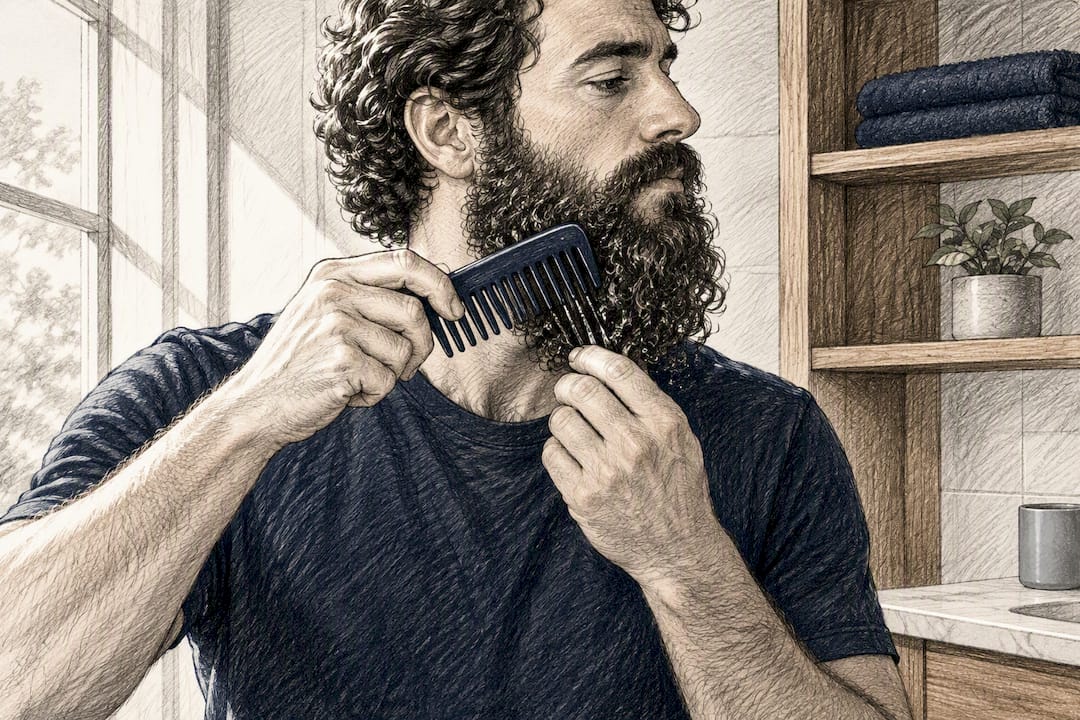
Start with your fingers to break up the biggest knots, then move to a wide-tooth comb, working from the ends up toward the chin, according to ShunSalon. Fingers give you feedback a comb can't: you feel exactly where a tangle sits before you pull on it.
Tool choice depends on beard length:
- Medium to long beards do best with a wide-tooth comb, which glides through coils without snagging.
- Short to medium curls respond well to a boar-bristle brush, which distributes oil evenly and helps train the curl pattern along the skin.
- Combine both if your beard has mixed lengths from recent trims.
Clean your tools weekly. Oil, dead skin, and product residue build up in the bristles and teeth, and a dirty comb reintroduces grime to a beard you just washed. Wash combs and brushes in warm water with a drop of the same sulfate-free cleanser you use on your beard, then air-dry them fully before the next use. Replace a wide-tooth comb once teeth start bending or a boar-bristle brush once bristles thin out and stop gripping hair the way they used to.
What Products Actually Define Curls Without Weighing Them Down
The layering method that works for scalp curls works for beard curls too: oil for hydration, cream or leave-in for definition, balm for hold. Skipping a step usually shows up fast, either as frizz (missing the cream step) or flyaway curls with no shape (missing the balm).
Start light and build up:
- Beard oil: two to four drops for a short beard, up to a dime-sized amount for a longer one, worked in at the roots first.
- Curl cream or leave-in: a pea-sized amount rubbed between palms before running through damp curls, focused on the mid-shaft and ends where dryness concentrates.
- Light balm: a dime to nickel-sized scoop, warmed between fingers, applied last to set the shape for the day or evening.
Watch the ingredient list on anything you buy. Alcohol-heavy sprays and heavy wax formulas dry curls out or glue them into an unnatural clump. Some silicones can also build up on hair over time and eventually require a clarifying wash to strip out, according to Healthline. If your beard starts feeling coated or heavy a few weeks into using a new product, that buildup is the likely reason, not a defect in your hair.
Pro Tip: Tighter curls generally need more product volume than looser waves because there's more surface area folding back on itself. Adjust upward gradually rather than guessing at a full dose on day one.
How Do You Trim a Curly Beard Without Creating Bald Spots?
Trim dry, not wet, for shaping work. Wet curls stretch out and look longer than they'll settle at once dry, which is exactly how curly-bearded men end up over-trimming and leaving patchy spots where the curl springs back shorter than expected. Wet trimming has a narrow use case: cleaning up a straight-edge neckline or cheek line where precision matters more than curl behavior.
A conservative, shape-first approach protects against that shrinkage trap:
- Trim dry so you're cutting the curl's true resting length, not its stretched length, following guidance from Wahl's curly beard trimming guide.
- Use scissors over clippers for shaping work; scissors let you remove individual split ends at an angle that follows the curl's natural bend instead of cutting a flat line across it.
- Trim in small passes and reassess between each one. Curly hair hides length until it's cut, so what looks even can shift once you step back.
If you're working with a barber, come prepared. Explain your curl pattern out loud, ask for conservative shaping rather than a dramatic length change, and bring a photo or point to the exact silhouette you want. A barber who trims curly beards the same way they trim straight ones is the single most common cause of the patchy look men blame on their hair type.
Can You Straighten a Curly Beard Safely?
Yes, temporarily, and the results last only until your next wash. A blow-dryer paired with a round brush, or a heated beard brush designed for facial hair, will pull curls straighter for a day or event, then the coil returns once moisture comes back into the shaft.
Heat has real trade-offs, so treat it as an occasional tool rather than a daily habit:
- Use the lowest effective heat setting and keep the tool moving in short passes rather than holding it against one section.
- Apply a heat protectant spray before every session; skipping this step is where most heat damage actually happens.
- Limit heat styling to a few times a week at most. Frequent heat use increases long-term frizz and dryness, which works directly against the moisture routine you've built.
- A blow-dryer with a brush or a heated beard brush both deliver a similar temporary straightening effect; pick whichever feels easier to control in your hands.
Longer-lasting straightening, keratin treatments or chemical relaxers, exists, but it comes from a professional stylist, not a home kit. Both processes alter the hair's internal bonds and carry real risk of dryness or breakage if done incorrectly, so a consultation before committing is worth the extra step.
Pro Tip: Keep heat styling for special occasions and let your curls run natural day to day. Your beard recovers faster from occasional heat than from daily exposure.
Overnight Habits That Protect Your Curl Pattern
What you do between 10 p.m. and 7 a.m. matters almost as much as your morning routine. A few drops of oil worked in before bed keeps the shaft hydrated overnight instead of drying out against cotton fibers.
Small changes compound fast:
- Switch to a satin or soft-cotton pillowcase; rough cotton pulls moisture out of curls and roughens the cuticle while you sleep.
- Apply a light balm before bed only if your beard tends to frizz overnight; skip it if your beard already holds shape fine without extra product.
- Resist touching or restyling your beard throughout the day. Constant handling breaks the curl's natural pattern and redistributes oil unevenly.
- Sleep, hydration, and a diet that includes enough protein and healthy fats all support the follicle health that curl definition depends on.
Why Small-Batch, Natural Formulas Fit Curly Beard Care
Oils like jojoba and argan work because they mimic the sebum your curls can't distribute on their own, coating the shaft close to how your skin's own oil would if the curve of the hair let it travel that far. Balms add a light, waxy hold that shapes curls without the heavy buildup thicker pomades leave behind.
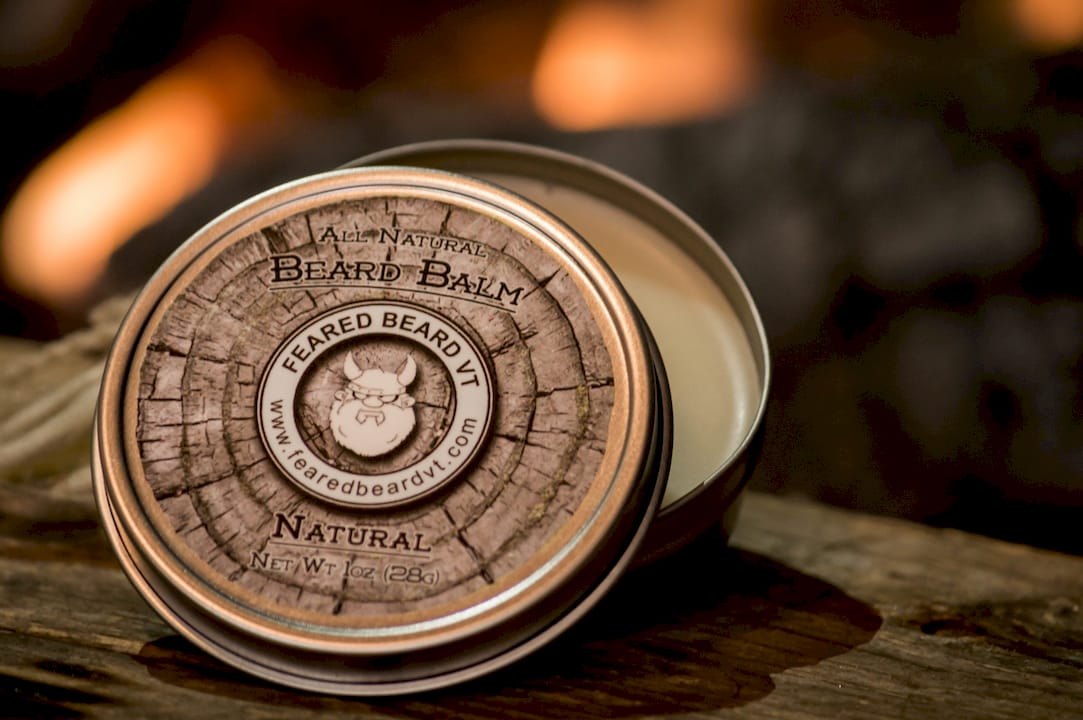
Feared Beard VT builds its lineup around that exact problem. The company is dedicated to crafting 100% natural, small-batch beard care products designed for healthier, better-nourished beards, rather than mass-produced formulas cut with fillers.
A few things worth knowing about the approach:
- The beard oils are built to hydrate and style in one step, aimed squarely at the dry, unruly texture curly beards are prone to.
- Every batch is hand-formulated in small runs rather than mass-produced, which keeps ingredient quality consistent from bottle to bottle.
- Repeat purchases and customer feedback suggest softness and manageability beyond marketing claims.
An Editor's Take on Managing a Curly Beard
Most curly beard advice treats curls as a problem to fix. They're not. They're a hair type that needs more moisture and less interference, full stop. The men who get the best results aren't the ones chasing the perfect straightener. They're the ones who stick to oil, a gentle wash, and a light hand with the scissors for two straight months before judging anything.
If you take one thing from this guide, make it patience with trimming. Overcutting out of frustration is the single fastest way to undo weeks of progress.
— Kyle
Start Your Curly Beard Routine With the Right Products
You don't need a five-step system before you can start seeing results. You need one good oil, one good balm, and the discipline to use them daily. That's the entire gap between a frizzy, unruly curly beard and a defined one, and it's the exact gap Feared Beard VT built its lineup to close: 100% natural, small-batch oils and balms with no filler ingredients diluting what actually hydrates and shapes curly hair.

If you're starting from zero, the Starter Beard Care Kit pairs an oil and balm together so you're not guessing which combination to buy first. The oil handles daily hydration on a damp beard; the balm handles shape and light hold once you're styled for the day. Prefer to build your own combination? Browse the full beard oils and beard balms lines individually, or check our ingredients page to see exactly what's going into every batch. Need a gift for a curly-bearded friend? A Gift Card starting at $25 lets them pick their own starting combination. Head to the shop and put together your first order today.
Sources
This guide draws on grooming technique research from ShunSalon, Wahl's trimming guide, Healthline's hair-health reporting, and YesMadam's curly beard guide. Readers who want deeper ingredient or technique detail should start there. Advanced conditioning options like QAI Liquid Hair are worth researching if you want to go further on repair-focused formulas.
- Mastering Curly Beard Care: Essential Tips For Healthy, Defined Curls | ShunSalon
- Why is silicone bad for hair? | Healthline
- How to Trim (and Tame) a Curly Beard
- How to Manage a Curly Beard? Grooming & Styling Tips
FAQ
How Do I Maintain a Curly Beard?
Apply beard oil daily to a damp beard, wash two to three times a week with a sulfate-free cleanser, and detangle only when slightly damp using a wide-tooth comb. Finish with a light balm for shape and trim conservatively every few weeks to keep the silhouette even.
What Is the 3-Month Beard Rule?
The 3-month beard rule refers to letting a beard grow untouched for a few months before shaping it, since early patchiness and uneven growth usually fill in over that stretch. For curly beards specifically, expect visible training and pattern consistency within four to eight weeks of steady care, even before the full three months are up.
How Can I Fix a Curly Beard That Looks Frizzy or Unruly?
Frizz almost always points back to dryness, so rehydrate with beard oil applied to a damp beard and switch to sulfate-free products if you're currently using regular shampoo. Detangle gently while damp rather than dry, and hold off on trimming until the beard is properly hydrated so you're not cutting against shrinkage.
Are Curly Beards Rare?
Curly beards aren't rare; curl pattern in facial hair simply follows the same genetics as scalp hair, so anyone with wavy or curly scalp hair usually grows a curly beard too. What varies more is how much care each curl pattern needs, since curly beards trap less sebum and dry out faster than straight ones.