
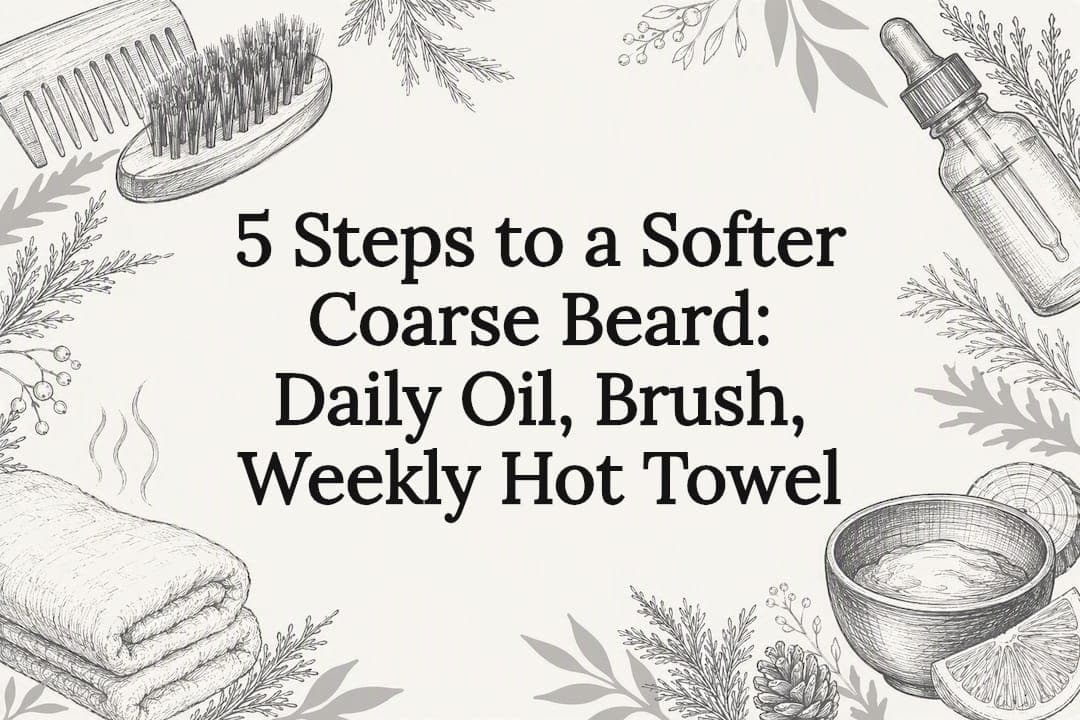
Softening a coarse beard starts with applying beard oil to a towel dried beard every day, working it down to the skin, then brushing it through with a boar bristle brush. Add one weekly hot towel session or a rinse out conditioner treatment, and trim dry with the grain every few weeks to remove split ends. Natural beard oil paired with beard balm covers both the daily and sealing steps this routine calls for.
TL;DR:
- Consistent application of oil on damp beard skin penetrates deeper and is more effective than applying on dry hair.
- Weekly hot towel treatments combined with rinse-out conditioner significantly improve moisture absorption and soften coarse beard hair.
- Using a boar-bristle brush after oiling distributes sebum, smooths the cuticle, and enhances softness over time.
- Avoid over-washing, alcohol-based products, and trimming wet hair, as these habits increase coarseness and hinder softening efforts.
- Proper shaving technique, including shaving with the grain and avoiding aggressive edges, helps prevent irritation that can worsen beard roughness.
Table of Contents
- A 5-Step Quick Routine You Can Start Today
- How to Structure Daily, Midweek, and Weekly Care for Lasting Softness
- What Beard Oils, Conditioners, and Balms Actually Do
- Brushes, Combs, and Trimming Techniques That Change How a Beard Feels
- Why Beards Stay Coarse and What to Expect
- Diet and Hydration Tips to Improve Beard Softness
- Common Mistakes That Worsen Beard Coarseness
- Use of Exfoliation to Promote Softer Beard Growth
- Natural Remedies and DIY Masks for Beard Softening
- Impact of Shaving Frequency and Technique on Beard Texture
- Why a Routine Beats Any Single Product
- Building Your Starter Routine With Feared Beard
- Sources
A 5-Step Quick Routine You Can Start Today
You don't need eight products and a morning ritual to feel a difference. You need five steps, done in the right order, starting today.
- Wash on wash day only. Use a beard specific or sulfate free cleanser two to three times a week. On the other days, just rinse with warm water so you don't strip the natural oils your beard needs to stay pliable.
- Towel dry without rubbing. Pat the beard gently. Rubbing roughs up the cuticle, which is the opposite of what you're trying to do.
- Apply beard oil while the hair is still slightly damp. Warm two to six drops in your palm, depending on beard length, and work it all the way to the skin, not just the surface hair. Daily oil application penetrates the hair shaft rather than just coating it, which is why skin-first application matters more than most guys assume.
- Comb first, then brush. A wide-tooth comb detangles; a boar-bristle brush spreads the oil evenly and smooths the cuticle down.
- Finish with balm if your beard is longer or unruly. A pea-sized amount seals in the oil and adds light hold without the stiffness of wax.
Pro Tip: Apply oil right after a shower, while pores are still open and hair is slightly damp. It absorbs faster and you'll use less product overall.
How to Structure Daily, Midweek, and Weekly Care for Lasting Softness
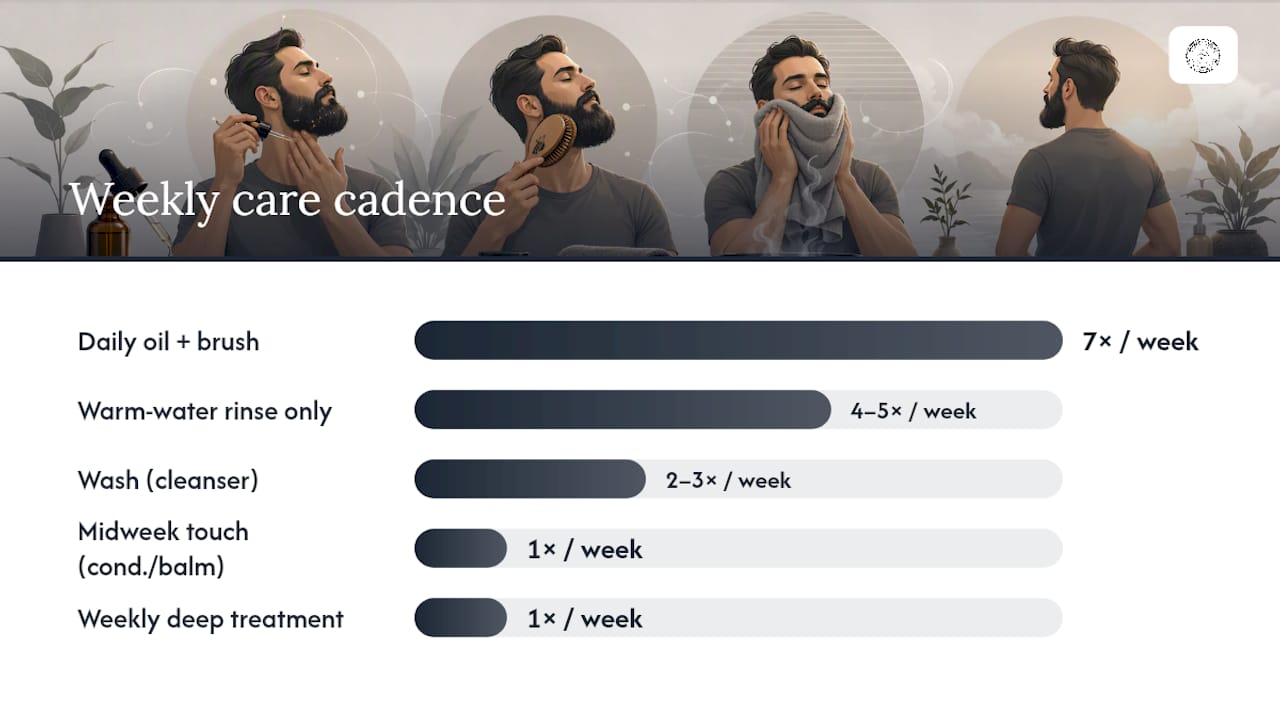
The five-step routine works as a one-day fix. Real softness, the kind that shows up in how your beard feels a month from now, comes from repeating it on a schedule that matches how your hair and skin actually behave.
Start by separating "wash day" from "rinse day." Wash day means two to three times a week with an actual beard cleanser. Every other day is a warm-water rinse only, no soap. Washing daily with regular shampoo or bar soap is one of the fastest ways to strip the oils that keep coarse hair flexible, and it's a mistake barbers see constantly.
From there, your routine breaks into three layers:
- Daily: oil after towel-drying, then one to two minutes of brushing to distribute it. If your skin runs dry, a light leave-in conditioner on top of the oil helps without weighing the beard down.
- Midweek: a quick top-up with leave-in conditioner or a light balm if your beard starts feeling dry or staticky before the next wash day.
- Weekly: this is where the real change happens. A hot towel treatment followed by a rinse-out conditioner, or a deep-oil mask left on before bed, gives moisture time to actually penetrate rather than just sit on the surface.
Combining oil for penetration, conditioner for cuticle smoothing, and balm for sealing is consistently the most effective approach for coarse or tightly coiled beard textures. It is more effective than any single product used alone.
Adjust the frequency to your own beard. A shorter beard with sensitive skin underneath might need washing down to twice a week. A longer, thicker beard can often handle three washes plus a heavier weekly treatment without irritation. There's no universal number, just a starting point to tune from.
What Beard Oils, Conditioners, and Balms Actually Do
Most guys grab a beard product without understanding what it's actually doing to the hair, which is how they end up disappointed by results. Each product in a beard routine has a distinct job, and using them in the wrong order or for the wrong purpose is why coarse beards stay coarse despite money spent.
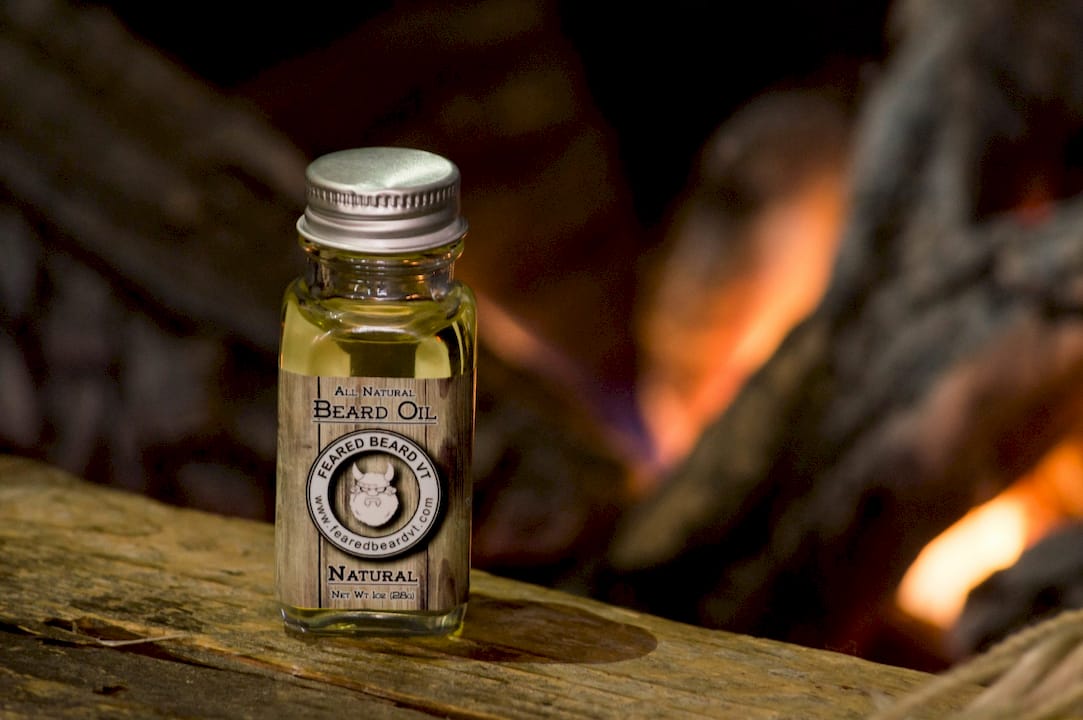
Beard oil uses carrier oils like jojoba and argan to penetrate the hair shaft itself, not just sit on top of it. Jojoba oil is especially effective because its molecular structure closely resembles human sebum, the natural oil your skin already produces. That's why oil belongs on damp, towel-dried skin, not on dry hair alone.
Conditioner works differently: it smooths the outer cuticle layer of each hair strand rather than penetrating it. Rinse-out conditioner is best saved for a weekly deep treatment, since it needs contact time to work. Leave-in conditioner, by contrast, is light enough for daily use and gives an immediate softness boost between washes.
Balm adds a sealing layer plus light hold, locking in whatever oil and conditioner already did their job underneath. Shea butter is one of the more effective balm bases for sensitive or dry facial skin because it sits on the surface without clogging pores the way heavier waxes can.
When picking products, run through a short checklist:
- Does it apply skin-first, or is it just a hair coating?
- Is it alcohol-free? (Alcohol-based styling products dry hair out and undo everything oil is trying to accomplish.)
- Does the scent and texture fit how you'll actually wear it daily?
For tightly coiled 4B or 4C beard textures, pairing a penetrating oil like jojoba with a surface conditioner like argan, and using both leave-in and rinse-out formulas, tends to outperform any single product approach.
The structure includes natural carrier oils for the daily step, and beard balm formulated with shea butter for guys whose skin reacts to synthetic fragrances or heavier wax bases.
Brushes, Combs, and Trimming Techniques That Change How a Beard Feels
The right tools do half the work oil and balm can't do alone. Barbers rely on a short list of techniques that most guys skip entirely, and skipping them is often the real reason a beard stays wiry no matter how much oil goes into it.
- Boar-bristle brush, one to two minutes, right after oiling. This distributes your skin's natural sebum along with the applied oil and physically smooths the cuticle flat instead of leaving it lifted.
- Wide-tooth wooden comb for detangling. Use it to check for split ends before they turn into breakage, and to work through knots without yanking hair out.
- Trim dry, never wet. Wet hair stretches and springs back differently than dry hair, which throws off the length. Trimming dry and cutting with the grain with thinning shears removes bulk without leaving the sharp, blunt edges that make a beard feel bristly against skin.
- Hot towel treatment, once a week. Warm a towel until it's hot but tolerable, hold it against the beard for 30 to 60 seconds, apply oil or conditioner while the cuticle is still open, then wrap for five to ten minutes before rinsing or towel-drying.
Hot towels temporarily open the hair cuticle, which is exactly why product applied during or right after the towel step penetrates deeper than product applied cold.
Pro Tip: Skip thinning shears near the jawline if your beard grows in patchy there. Removing bulk works best on the fuller cheek and neck areas, not the spots already thin.
If your beard has grown out unevenly or has a shape you can't fix with a home trim, a one-off visit to a barber for a structural cut resets the baseline. Everything above maintains it from there.
Why Beards Stay Coarse and What to Expect
Coarse texture usually comes from one or more of these: chronic dryness, a lifted cuticle that catches light and friction, short new stubble that hasn't had time to grow past its stiff phase, hard water stripping natural oils, or straightforward genetics that no product changes completely.
- If itching is the main complaint, oil relief works within minutes; a short-term balm helps through the day.
- If hard water is stripping oils faster than you can replace them, a shower filter or switching to a sulfate-free cleanser often solves what oil alone can't.
- Expect surface softening the same day you apply oil or conditioner, but real structural change (finer feel, less frizz, easier lay-down) takes two to eight weeks of consistent care.
- If you're seeing more breakage, irritation, or zero change after eight weeks, the routine itself needs adjusting, not more product piled on top of it.
Diet and Hydration Tips to Improve Beard Softness
Topical care handles the surface. What you eat and drink handles the hair you haven't grown yet. Coarse, brittle beard hair often traces back to gaps that no oil will fix from the outside.
Protein is the building block of keratin, the structural protein that makes up hair itself. A diet consistently low in protein shows up as weaker, more brittle strands over time. Essential fatty acids, the kind found in fish, walnuts, and flaxseed, support the same lipid layer that beard oil is trying to replicate topically. You're essentially reinforcing from the inside what jojoba and argan do from the outside.
Water matters more than most guys think. Dehydrated skin produces less natural sebum, which means less of the oil that keeps beard hair flexible at the root. Adequate hydration and nutrition support long-term hair strength even though topical products remain the fastest way to address surface dryness day to day.
None of this replaces your oil and brush routine. Think of it as the difference between watering a plant's roots versus wiping down its leaves. Both matter, but they solve different problems. A beard fed by cracked, dehydrated skin will fight your oil no matter how much you apply, because you're treating the symptom while the underlying skin stays starved.
If you're already washing correctly, oiling daily, and doing your weekly deep treatment but still seeing no improvement after several weeks, look at your plate and your water intake before assuming the product is failing you.
Common Mistakes That Worsen Beard Coarseness
Most coarse-beard frustration isn't a hair problem. It's a habit problem, and a few habits do more damage than people realize.
Over-washing with regular shampoo or bar soap is the biggest one. Daily washing with products meant for scalp hair or body skin strips the natural oils that keep beard hair pliable, forcing you into a cycle where you apply oil just to replace what the wash removed hours earlier.
Skipping the skin underneath. Oil applied only to the visible hair, not down to the skin, treats the symptom instead of the source. Dry, flaky skin under a beard produces coarser-feeling hair no matter how much product sits on top of it.
Using alcohol-based styling products. Anything with alcohol high on the ingredient list dries hair out fast, which is the exact opposite of the "slip and flexibility" barbers aim for over stiff hold.
Trimming wet. Wet hair behaves differently than dry hair under scissors, and cutting against the grain instead of with it leaves blunt, sharp edges that feel bristly for weeks after.
Expecting overnight results. Applying oil once and judging the routine a failure by the next morning skips past the two-to-eight-week window structural change actually needs.
Ignoring beard length as a variable. Short, newly emerged hairs are stiffer by nature, since they need a sharp end to push through skin. If you're in the first few weeks of growing out, the coarseness you feel isn't a product failure. It's timing.
Fix the habit before blaming the product. A great oil applied over a broken routine will underperform every time.
Use of Exfoliation to Promote Softer Beard Growth
Dead skin buildup under a beard traps oil before it can reach new hair growth, and it's one of the more overlooked reasons a beard stays coarse despite a solid oiling routine. Exfoliating the skin underneath, not the hair itself, clears that buildup so product actually reaches the surface it's meant to treat.
A soft-bristle facial brush or a gentle exfoliating cleanser used once or twice a week is enough. You're not trying to scrub aggressively. You're clearing dead cells so oil absorbs into skin instead of sitting on a layer of flakes that eventually shed and take the oil with them.
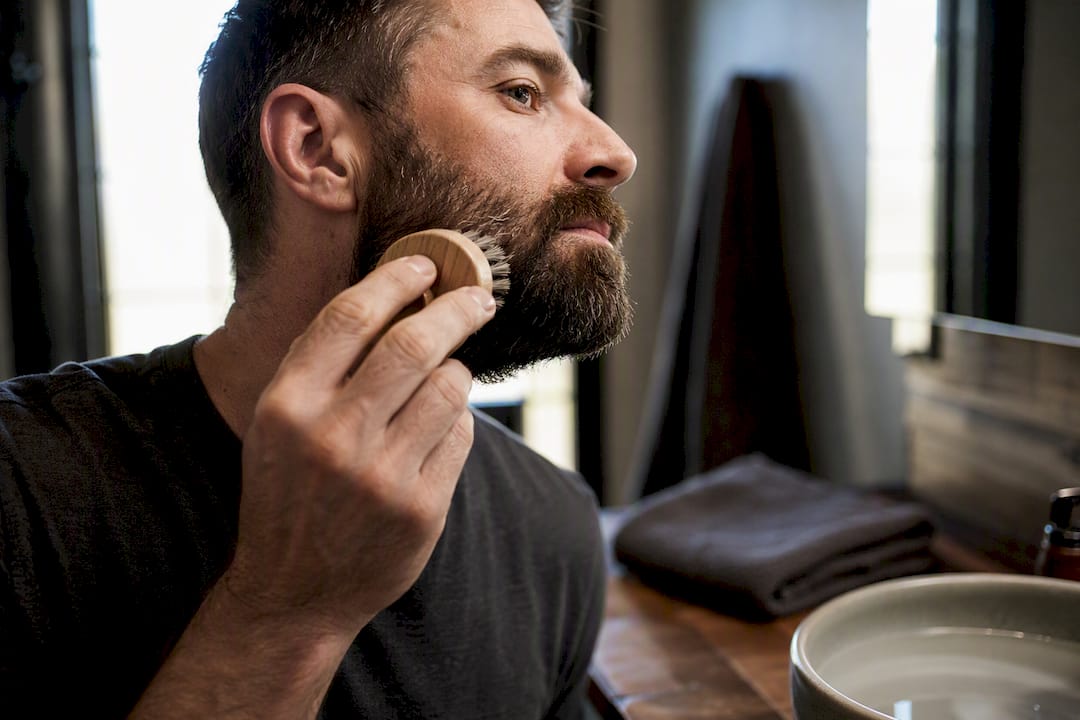
This matters most for guys dealing with beardruff, that flaky white buildup that shows up at the roots. Beardruff is often a sign that dead skin isn't being cleared, and no amount of oil fixes that until the exfoliation step gets added. Once the skin underneath is clear, the same oil you were already using starts performing better because it has direct access to skin instead of a barrier of dead cells.
Pair exfoliation with wash day rather than doing it separately. Right before your beard-specific cleanser, spend thirty seconds working an exfoliating brush or scrub in circular motions against the grain, then wash normally and follow with oil once towel-dried. Overdoing it, more than twice a week, can irritate sensitive skin and cause the same dryness you're trying to fix, so treat it as a supporting step, not a daily habit.
Natural Remedies and DIY Masks for Beard Softening
Kitchen-cabinet treatments won't replace a real routine, but a few have legitimate softening effects worth knowing, especially if you want an occasional deep treatment without buying another product.
A honey and yogurt mask left on for fifteen to twenty minutes before rinsing acts as a light humectant, drawing moisture into the hair shaft. It works best right before a hot towel session, since the warmth helps the mixture penetrate rather than just sit on the surface.
Coconut oil, warmed slightly and worked into a towel-dried beard, functions similarly to jojoba in that it penetrates rather than coats, though it can feel heavier on finer beards. It's a reasonable stand-in for a weekly deep-oil mask if you already have it in the kitchen.
An avocado mash applied as a mask brings natural fats and moisture that mimic what a rinse-out conditioner does structurally, smoothing the cuticle from the outside. Leave it on for ten minutes under a warm towel, then rinse thoroughly, since food-based masks can leave residue if not cleaned out fully.
None of these replace a formulated oil or balm built specifically for beard hair, and food-based masks require more cleanup and carry a higher risk of clogging pores if not rinsed properly. Treat them as an occasional weekend addition to your weekly deep-conditioning slot, not a replacement for the daily oiling routine that does most of the actual work.
Impact of Shaving Frequency and Technique on Beard Texture
How you shave the edges and neckline affects how the rest of the beard behaves, even though you're only cutting a small portion of it. Frequent, aggressive shaving along the borders can lead to more ingrown hairs and irritated skin right at the boundary, which then affects how the adjacent beard hair grows in.
Shaving with the grain, rather than against it, reduces the sharp, angled cuts that cause ingrown hairs and razor burn along your neckline and cheek lines. Against-the-grain shaving gets a closer cut, but it also increases the odds of irritation that spreads into the beard itself as inflammation.
Frequency matters less than technique here. Shaving your neckline every two to three days with a sharp, clean blade and proper prep (warm water, a pass with beard oil beforehand to soften stubble) causes far less texture disruption than shaving daily with a dull blade against the grain. Dull blades tug rather than cut, which roughs up the follicle opening and can contribute to coarser-feeling regrowth right at the edges.
If you're shaving your entire face and starting a beard from scratch, know that the first few weeks of stubble will always feel stiffer than mature beard hair. That's simple biology, short hair needs a sharper end to break through skin. It softens naturally as it grows past that early stage, and no product accelerates that particular phase much beyond what patience does.
Why a Routine Beats Any Single Product
The biggest misconception about softening a coarse beard is that one great oil solves it. It doesn't. The guys who see the fastest, most lasting change are the ones who treat softening as a schedule, not a purchase. Daily oil, weekly deep conditioning, occasional trims with the grain. That combination outperforms any single premium product used inconsistently.
Some beard care lines build their products around that reality: small-batch, natural formulations meant to support a routine rather than promise an overnight fix. No filler ingredients, no synthetic stand-ins for what jojoba or shea already do well. Consistency, not a miracle bottle, is what actually changes how coarse hair feels over a couple of months.
— Kyle
Building Your Starter Routine With Feared Beard
If you're putting this routine into practice, you need exactly two products to start: a natural beard oil for the daily skin-first step, and the Frosted Woods Beard Balm to seal it in when your beard needs more hold or extra protection against dry air. Feared Beard makes both in small batches with natural ingredients only, no synthetic fillers standing in for what real carrier oils and shea butter already do.

Use the oil every day after a towel-dried shower, two to six drops depending on length, worked straight to the skin before you brush it through. Reach for the natural beard balm with shea on colder days or after your weekly hot-towel session, when your beard needs an extra sealing layer to hold onto the moisture you just worked in. If sensitive skin has kept you from balm before, the shea-based formula is worth trying since it skips the heavier waxes that tend to irritate.
Start with the oil and balm pairing, run it for a few weeks on the schedule outlined above, and judge results at the eight-week mark rather than after a single application. That's the timeline coarse hair actually needs to show real change.
Sources
- How to get a softer beard, according to a barber | British GQ
- How To Soften Beard Hair — The Manual
- How to Soften Your Beard (7 Methods That Work) — Cultured Grooming
- How to soften beard — Healthline